

World's most advanced! New liquid carbon dioxide transport vessel certified
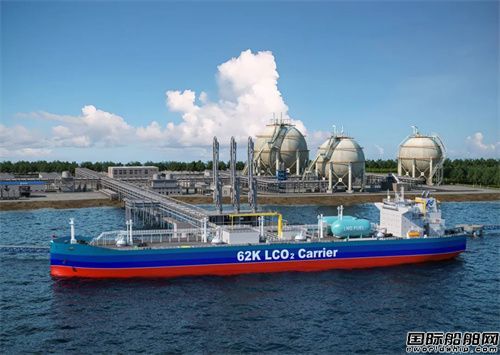
Recently, a ceremony was held in Malaysia to issue the General Arrangement and System Approval (GASA) certificate for a 62,000 cubic meter liquid carbon dioxide carrier (LCO2 CARRIER), whose front-end engineering design was undertaken by Shanghai Ship Research and Design Institute (SDARI) of China Shipbuilding Group Co., Ltd..
The vessel design, reviewed by DNV, was developed by SDARI for Petronas CCS Ventures (PCCSV), a wholly-owned subsidiary of Petronas, MISC Berhad, and Mitsui O.S.K. Lines (MOL). It represents one of the industry's most advanced designs for large-scale, low-pressure liquid carbon dioxide carriers. With the establishment of the joint venture company Jules Nautica Sdn. Bhd. and the completion of the front-end engineering design of the LCO2 carrier, the project will enter the construction and operational preparation phase.
Leveraging its extensive experience and superior design capabilities, SDARI provided a comprehensive technical solution and offered PCCSV, MISC Berhad, and MOL comprehensive technical support and assurance. Through close collaboration with the three shipowners, SDARI actively participated in project discussions and exchanges, continuously optimizing the design scheme and applying the latest research findings to create a liquid carbon dioxide carrier with international competitiveness.
In the future, SDARI will further increase its R&D investment in low-carbon shipping, collaborate with more domestic and international companies, continuously explore new technologies and vessel types, and contribute more to the green transformation of the global shipping industry.
It is understood that PCCSV, MISC, and MOL signed a cooperation agreement last May, and recently announced the establishment of the joint venture company Jules Nautica Sdn. Bhd. to jointly develop and invest in LCO2 carriers. The joint venture will lead the development of LCO2 carriers and ultimately own and operate them. Such vessels are crucial for transporting LCO2 to designated storage locations to facilitate the implementation of carbon capture and storage (CCS) projects.
According to the plan, the joint venture will prioritize support for future carbon capture and storage (CCS) projects in the Asia-Pacific region and is expected to play a key role in improving the CCS value chain.
Related News
Ministry of Foreign Trade
Fixed line:0553-2111515
E-mail (E-mail):licheng@wuhupa.com
Address: Xu Town Industrial Park, Wuhu City, Anhui Province
Public Number
Micro-blog
Tiktok
Copyright©2022 Wuhu Ping'an Rubber Co., Ltd. All Rights Reserved Website Construction:www.300.cn Nanjing SEO