

Southeast Shipbuilding launches 18,500-ton oil chemical tanker
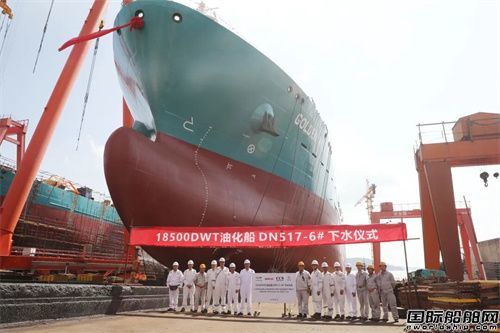
On September 7th, the 18,500 DWT oil-chemical tanker (DN517-6) built by Southeast Shipbuilding under Fujian Shipbuilding was successfully launched.
This type of vessel has an overall length of 149.8 meters, a beam of 22.8 meters, and a depth of 12.7 meters. It is mainly designed to transport crude oil, petroleum products with a density less than 1.54 tons per cubic meter, chemical products (Class II and III), liquid chemicals, including MARPOL Annex I and IMO Class II and III petroleum products listed under IBC regulations. The main engine and generator set are equipped with Selective Catalytic Reduction (SCR) devices for nitrogen oxide emission control, meeting IMO Tier III requirements and Ice Class 1C strengthened standards for ice regions.
This vessel type adopts a multi-load line design to meet the requirements of different flag states and ports; the liquid cargo system is designed with six independent transmission systems driven by variable frequency hydraulic drives, simultaneously operating six liquid cargo pumps and one ballast pump, enabling the unloading of six groups of liquid cargo at the same time. Each liquid cargo pump has a discharge rate of 300 cubic meters per hour, with a maximum discharge rate of 1,800 cubic meters per hour. The propulsion system uses a low-speed two-stroke diesel engine paired with a controllable pitch propeller and a forward energy-saving rudder bulb device, as well as a flap rudder with a rudder bulb. It is also equipped with a variable frequency shaft generator set, allowing operation without the generator set during navigation, which reduces ship energy consumption while improving maneuverability.
Fujian Shipbuilding has become quite mature in constructing this vessel type. Through continuous optimization of production organization and efficiency improvement, promotion of technological empowerment and process upgrades, strengthening efficient supply chain collaboration and risk management, it has systematically summarized the difficulties, improvements, and solutions encountered during the construction process, forming standardized operation manuals and process documents. These have been rapidly promoted and applied to subsequent vessels, truly achieving "faster and better construction," ensuring the remaining vessels in this series are delivered on schedule with high quality.
Related News
Ministry of Foreign Trade
Fixed line:0553-2111515
E-mail (E-mail):licheng@wuhupa.com
Address: Xu Town Industrial Park, Wuhu City, Anhui Province
Public Number
Micro-blog
Tiktok
Copyright©2022 Wuhu Ping'an Rubber Co., Ltd. All Rights Reserved Website Construction:www.300.cn Nanjing SEO