

Building a carbon-neutral port! Kawasaki Kisen orders electric tugboats
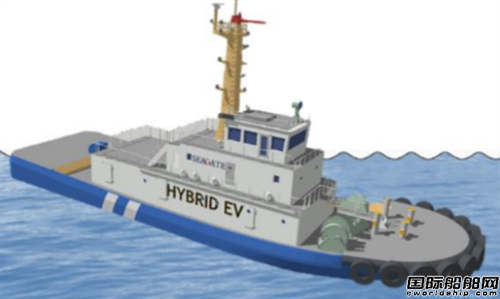
On September 17, Seagate Corporation, a subsidiary of Japan's Kawasaki Kisen, announced that it has reached an agreement with Kanagawa Dockyard to order an electric tugboat powered by high-capacity lithium-ion batteries.
The vessel is scheduled for completion in the second half of 2027 and will be deployed at the Tokuyama-Shimonoseki Port in Yamaguchi Prefecture. Located adjacent to West Japan's largest chemical industry base, the port is actively working to become a hub for clean energy supply. This electric tugboat will handle ship entry and exit operations as well as security tasks at the port, contributing to the development of a carbon-neutral port (CNP).
Kawasaki Kisen initially announced its plan to build an electric tugboat in July 2022 and engaged in in-depth discussions with Kinugawa Shipbuilding and equipment manufacturers regarding the vessel's detailed design. Thanks to advancements in the miniaturization of shipboard equipment and the introduction of newly developed, domestically produced technologies—both of which enhanced maintenance performance—the company ultimately reached a construction agreement with Kinugawa Shipbuilding.
The vessel will feature a hybrid electric propulsion system, incorporating several cutting-edge technologies—new to Japanese tugboats—into its drive motors, steering mechanisms, and current-control systems. The tugboat is equipped with a generator set that can provide auxiliary power to the electric propulsion system when lithium-ion battery capacity is insufficient. Compared to conventional tugboats powered by heavy-oil main engines, this innovative system significantly reduces fossil fuel consumption and carbon dioxide emissions.
This project has been jointly selected by Japan’s Ministry of Economy, Trade and Industry and the Ministry of Land, Infrastructure, Transport and Tourism as a demonstration project under the "2025 Fiscal Year Subsidy Program for Energy Consumption Rationalization and Transition to Non-Fossil Energy in the Transportation Sector," aiming to promote energy efficiency and emissions reduction in Japan’s coastal shipping industry, as well as advance the adoption of non-fossil energy sources and accelerate the decarbonization process in the nearshore vessel sector.
According to Kawasaki Kisen's goals, by 2030 the company aims to reduce its carbon dioxide emissions by 50% compared to 2008 levels—exceeding the International Maritime Organization's (IMO) own 2030 target of a 40% reduction. Moreover, Kawasaki Kisen has gone a step further by committing to achieve net-zero emissions by 2050. To make this possible, the company is actively pursuing alternative fuels that can significantly cut emissions and plans to introduce zero-emission vessels into its fleet before 2030.
Related News
Ministry of Foreign Trade
Fixed line:0553-2111515
E-mail (E-mail):licheng@wuhupa.com
Address: Xu Town Industrial Park, Wuhu City, Anhui Province
Public Number
Micro-blog
Tiktok
Copyright©2022 Wuhu Ping'an Rubber Co., Ltd. All Rights Reserved Website Construction:www.300.cn Nanjing SEO