

Milestone! The world's first zero-emission, fully automated container ship has been in operation for 3 years
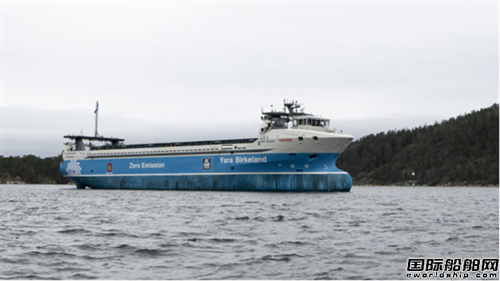
Recently, the "Yara Birkeland," the world's first zero-emission, fully autonomous container ship, marked its third anniversary of operation.
The "Yara Birkeland" is an 80-meter-long, all-electric container ship jointly developed by Norway's Kongsberg Group, built by the Norwegian shipyard VARD, and financially supported by Enova, a Norwegian government-owned enterprise. The ship uses a Marin Teknikk MT207 design, measuring 80 meters in length and 15 meters in width. It can carry 120 twenty-foot equivalent units (TEUs), has a normal speed of 6 knots, and a maximum speed of 13 knots.
The "Yara Birkeland" was officially completed and delivered at the end of 2020. After a series of tests, it completed its maiden voyage in November 2021. It officially began operations in the spring of 2022, transporting fertilizer from Yara International's Porsgrunn plant in Norway along the fjord to Brevik port. It operates twice a week on the Porsgrunn-Brevik route, carrying up to 100 containers and collecting data along the 13-kilometer route.
Since its launch in 2021, the "Yara Birkeland" has demonstrated the enormous potential of zero-emission shipping. Equipped with a Leclanche MRS-2 marine battery system with a capacity of 6.8 megawatt-hours, it operates entirely without fossil fuels, reducing greenhouse gas emissions and lowering operating costs.
Over the past three years, the "Yara Birkeland" has completed over 250 voyages, transporting more than 35,000 containers. This has replaced approximately 35,000 diesel truck trips, reducing CO2 emissions by 1,000 tons annually and improving noise and dust pollution in residential areas due to reduced truck traffic.
Recently, the ship has also made progress in autonomous navigation, successfully achieving supervised automatic docking and cruising operations, paving the way for fully autonomous navigation.
Phil Broad, CEO of Leclanché's e-Mobility division, stated: "We are proud to be a key enabler of the success of the Yara Birkeland. This unique vessel represents a significant step forward for the decarbonization of the shipping industry, showcasing the potential of battery-powered solutions in large-scale maritime applications. The achievements of the past three years underscore the necessity of continued investment in clean energy technologies."
Jon Sletten, project manager for the "Yara Birkeland," emphasized: "This vessel has made a significant contribution to improving the global and local environment. Our project has received significant global attention and has inspired other maritime projects aimed at reducing emissions."
It is understood that the "Yara Birkeland" uses advanced technology developed and delivered by Kongsberg Maritime, including sensors and integration required for remote control and unmanned autonomous operation, as well as electric propulsion, battery, and control systems. The ship will be operated by Massterly, the world's first unmanned ship company jointly established by Kongsberg Maritime and Wilhelmsen, from a monitoring and operation center located in Horten.
The ultimate goal of the "Yara Birkeland" is to achieve completely "unmanned sailing" without any crew on board. The ship will navigate with the assistance of sensors, including radar and cameras, which will input data into artificial intelligence (AI) to detect and classify water obstacles. The captain's work will be transferred to land, in a remote operation center 80 kilometers away, where multiple vessels may be monitored simultaneously.
In addition to autonomous driving, the "Yara Birkeland" can even achieve automatic unloading. In 2018, Yara International reached an agreement with Cargotec's Kalmar to provide automated loading and unloading solutions between fertilizer production equipment and the dock for the "Yara Birkeland."
Furthermore, the "Yara Birkeland" is equipped with an automated mooring system from MacGregor, a Cargotec company. This system enables mooring operations without human intervention, supporting efficient operation of the all-electric, zero-emission vessel.
Related News
Ministry of Foreign Trade
Fixed line:0553-2111515
E-mail (E-mail):licheng@wuhupa.com
Address: Xu Town Industrial Park, Wuhu City, Anhui Province
Public Number
Micro-blog
Tiktok
Copyright©2022 Wuhu Ping'an Rubber Co., Ltd. All Rights Reserved Website Construction:www.300.cn Nanjing SEO