

China Shipyard Builds! World's First Commercial LCO2 Carrier Completes First Loading
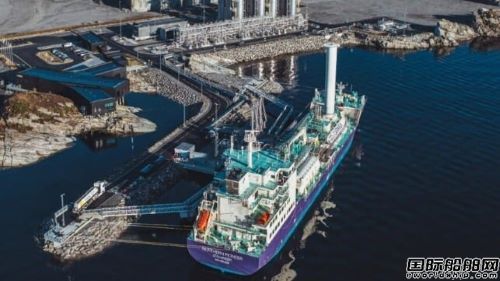
Recently, the "Northern Pioneer," the world's first commercially built 7500 cubic meter liquid carbon dioxide (LCO2) transport vessel, completed its first batch of carbon dioxide loading operations.
Borealis said: "We are proud to announce that commissioning has commenced and liquefied CO2 from our first customer, Heidelberg Materials, has now been loaded onto the Northern Pioneer, marking a significant milestone for Europe's first open commercial CO2 transport and storage value chain."
Borealis was jointly established by three European energy giants: Equinor, Shell, and TotalEnergies. In 2021, it ordered the first two 7500 cubic meter LCO2 transport vessels from Dalian Shipbuilding. At that time, these were the largest LCO2 transport vessels with the largest liquid cargo capacity in the world known to have signed construction contracts, specifically serving marine carbon transport and storage.
In November last year, the first vessel in the series, "Northern Pioneer," was officially delivered. The vessel is approximately 130 meters long, 21.2 meters wide, has a draft of 8 meters, flies the Norwegian flag, and is classed by DNV. It was independently designed and built by Dalian Shipbuilding and has completely independent intellectual property rights. The ship is equipped with two full-pressure C-type liquid cargo tanks made of special materials for transporting carbon dioxide, with a maximum bearing pressure of 19 barg and capable of withstanding temperatures as low as -35℃. The main engine is configured with two fuels: liquefied natural gas and marine light diesel oil. The ship's sulfur oxide and nitrogen oxide emissions meet the strictest requirements.
This type of vessel uses a variety of innovative technologies, including rotary sails, bubble drag reduction, main engine exhaust gas monitoring systems, and shaft-driven generators, significantly reducing emissions and improving energy efficiency, meeting the requirements of the most advanced Energy Efficiency Design Index (EEDI Phase III). By combining LNG power with wind-assisted propulsion and air lubrication technology, the new vessel's carbon footprint will be reduced by 34% compared to vessels using traditional fuels.
The Borealis project is the world's first project that allows industrial companies to transport and store their carbon dioxide emissions. Approved by the Norwegian government in 2020, the project is listed by the EU as a "Project of Common Interest" (PCI). It aims to transport, receive, and permanently store carbon dioxide in geological formations approximately 2600 meters deep beneath the seabed in the northern North Sea, helping European industrial companies reduce their carbon dioxide emissions.
In the first phase, the Borealis project is expected to provide 1.5 million tons of carbon dioxide storage capacity per year, including the transport and storage of carbon dioxide from Heidelberg Materials' cement plant in Brevik. In addition, Borealis plans to develop the second phase of the project, increasing the transport and storage capacity from 1.5 million tons per year to at least 5 million tons.
Related News
Ministry of Foreign Trade
Fixed line:0553-2111515
E-mail (E-mail):licheng@wuhupa.com
Address: Xu Town Industrial Park, Wuhu City, Anhui Province
Public Number
Micro-blog
Tiktok
Copyright©2022 Wuhu Ping'an Rubber Co., Ltd. All Rights Reserved Website Construction:www.300.cn Nanjing SEO